
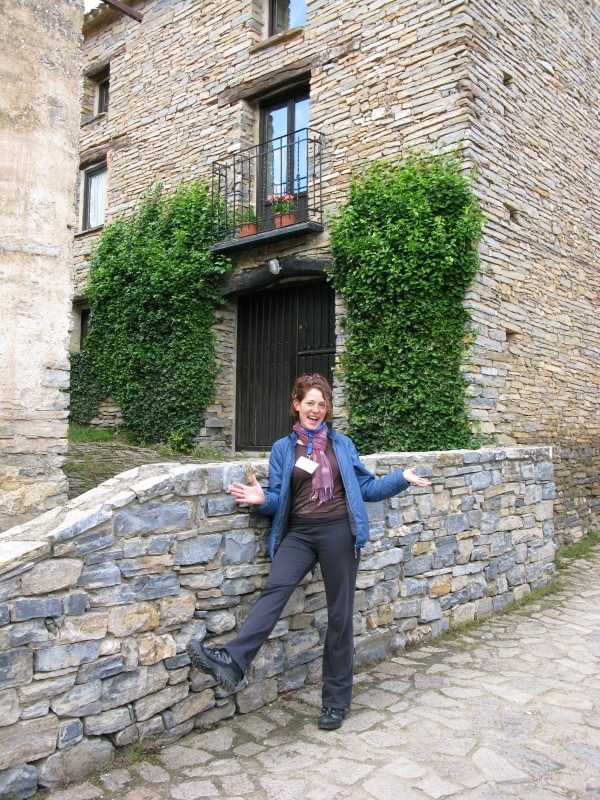
As I sit on the bus departing from the old restored town of Valdelavilla for the second of my two weeks of volunteering in trade for free accommodation in Spain with Vaughan Town, I am very sad. But then I reflect on the dozens of new friends I have all over the world; I imagine how and when we’ll see each other again, and I’m energized and excited.
A few years ago, I read an article online about how I could have an all-expenses paid trip in Spain, in exchange for simply conversing in English with Spaniards who want to improve their conversational English skills. I wasn’t sure it was a legitimate opportunity (it seemed too good to be true), but I bookmarked it anyway, figuring I could investigate it when I eventually made it to Spain to visit Madrid and beyond.
Which of course, I did.
This post was originally published in 2010. It has since been updated for accuracy of links and content.
This post got a Major Update in November 2019, with links to similar programs to Vaughan Town in other European Countries at the end!
Vaughan Town Overview
Vaughan Town (visit their site here) lived up to its reputation and word, and is indeed a legitimate volunteer experience. Although it’s not exactly too good to be true (you certainly earn your keep), it’s one of the most rewarding cultural experiences I could have possibly hoped for in Spain.
And I didn’t even get to speak a word of Spanish. (See also: How to Become Fluent in Spanish – and Other Languages)
The program is paid for mainly by Spanish companies who send their employees on a week-long “retreat” to improve their English skills. English is an important part of business in Spain, and many companies are willing to pay top dollar to help their employees become more fluent. Other Spanish attendees include individuals, and some post-secondary school programs that incorporate it into their curriculum.
Thus, the English-speaking volunteers attend the program for free, their value inherent simply in being willing and able to dedicate a week to chatting in English with the program participants.
Click here to learn about other ways to get free accommodation around the world.
Getting There
After meeting some of the “Anglos” (as we’re referred to throughout the week) at a tapas reception on Saturday night in Madrid, we are loaded onto a bus on Sunday morning. Although Vaughan Town has a few locations in Spain, both of my volunteer weeks take place at Valdelavilla (four hours from Madrid), which I’ll discuss shortly. Although most of the people on the bus are Anglos, a few Spaniards who live in Madrid also tag along for the ride.
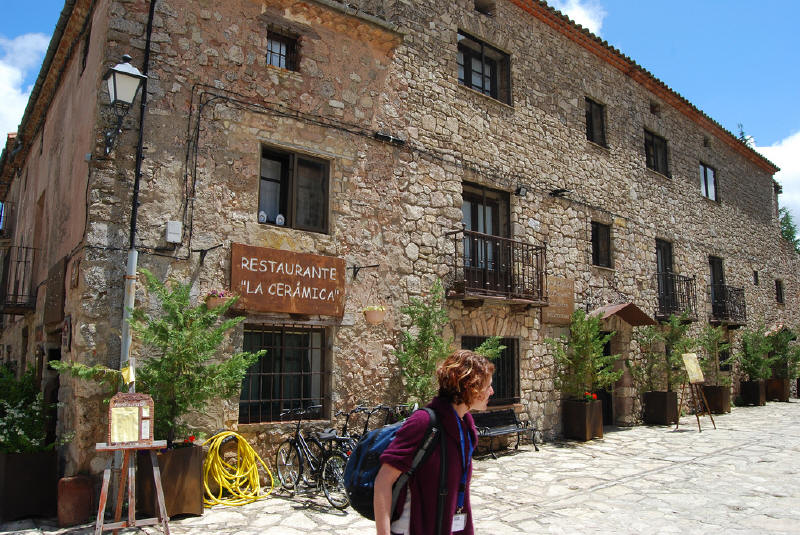
After a four hour drive and a stop for lunch in an old Spanish town, we arrive at Valdelavilla. We sit through an orientation session where we officially meet the week’s Master of Ceremonies (Greg), we each introduce ourselves, and learn what the week holds in store for us.
“We don’t have a lot of rules here,” Greg starts, “but we do have one that we’re quite serious about: No Spanish allowed! If we overhear you speaking in Spanish, you’ll get a warning. If we hear you do it again, you’ll be asked to leave. We mean it! You’re all here to speak in English, and all the Spaniards have enough English skills to get by. Use it and improve it!”
With this point of seriousness and the orientation out of the way, we meander down through the old village to the reception building and check into our rooms.
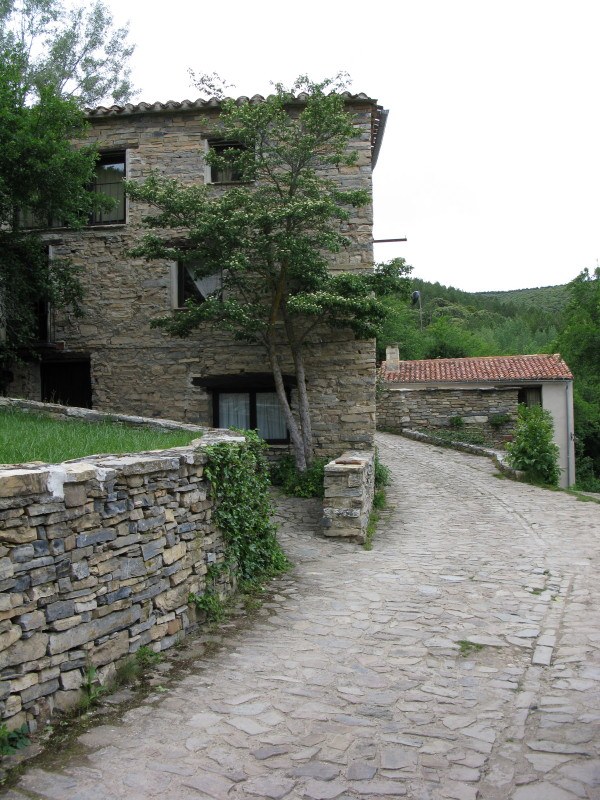
Valdelavilla
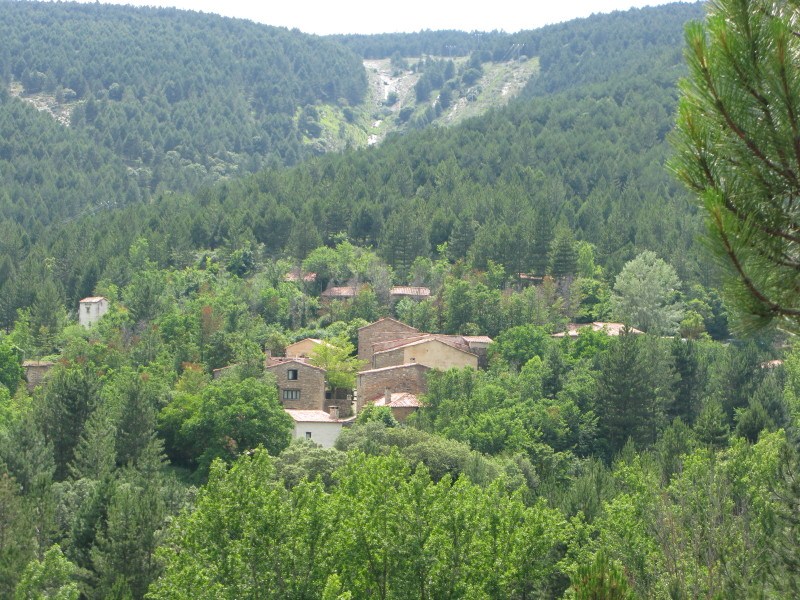
2018 Update: Valdelavilla is no longer in operation. However, Vaughan Town – along with a collection of other similar programs mentioned at the end of this article – often operates in similar locations; off the beaten track, and relatively isolated to create a truly English-immersive environment.
Valdelavilla is a tiny Spanish town in northern Spain (near Soria) that was abandoned in the 1960s due to changing demographics and industry, and restored in the 90’s. It is nestled at the base of a green mountainous valley, 2kms vertically below the nearest road to anywhere. Although there is a WiFi connection (albeit only available in a small range and at less than admirable speeds), cell phones cease to work about 2/3 of the way down the road into the village. The lack of technology adds to the ambiance; Valdelavilla is isolated, charming, and stunningly beautiful.
As participants of the Vaughan Town program, we pretty much take over the town. When Vaughan Town doesn’t use the village, it is rented out for weddings, corporate retreats, and private functions. I believe individuals can also visit for a meal, a walk, or an overnight stay as well.
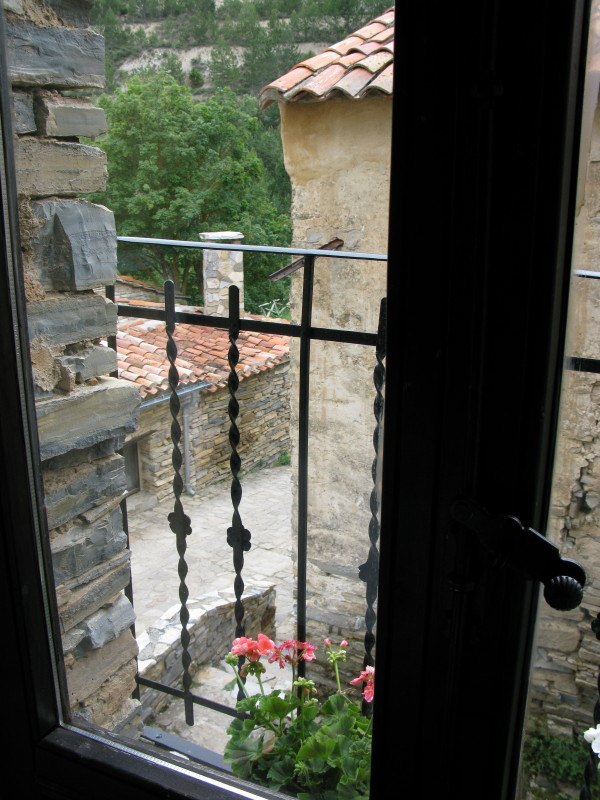
Accommodation is provided in the restored village houses, and in most cases up to five people are put up in each house, each person receiving their own room with ensuite bathroom. Although the amenities are rustic and at times a touch impractical (for example there is many a doorway and shower stall that is less than five feet tall!), it adds to the overall charm, as you can feel the history that prevails in Valdelavilla.
Each Day’s Events
The Anglos are a varied group; an intentional mix of ages, accents, and backgrounds. This is intended to expose the Spaniards a wide variety of conversation styles and sounds, improving their global English skills.
And as I said earlier, the Anglos (English-speaking volunteers) earn their keep on the program, with a busy schedule and lots of talking.
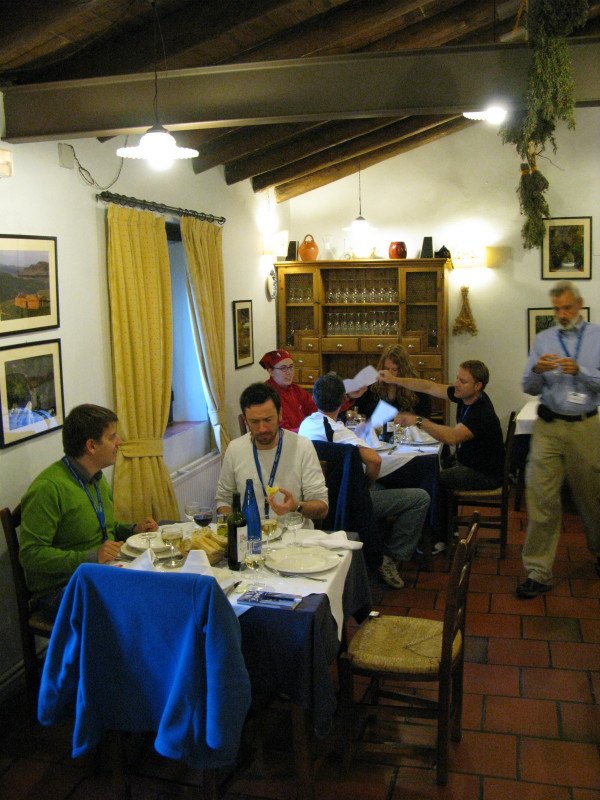
Breakfast begins at 9am, as does the conversation. We are instructed to ensure that there is an equal mix of Anglos and Spaniards at each table during meals, and we mix and match at will.
At 10am, we begin the “one-to-ones”. The program coordinator creates a schedule each day that pairs off the Anglos and Spaniards each hour for – you got it – English conversation. We can talk about anything under the sun, although we are cautioned against religion, politics, and the standard “what do you do, where do you do it” cocktail chat. I initially worry what I could possibly talk about with so many different people each hour, but almost never find dead air during the one-to-one sessions. In fact, an hour is a perfect amount of time to have a well-rounded conversation (often accompanied by a walk on the surrounding trails) before moving on to a new person and different conversation.
After four hours of one-to-one chatting, lunch is served at 2pm. Although for the Anglos this initially seems to be very late, it is the Spanish norm, and is a routine we all slip into fairly quickly.
Lunch is a three-course meal which normally lasts about an hour and a half, and then it’s siesta time! We have free time until 5pm, which many people use in different ways: catching up on work, surfing the internet, sleeping, walking, playing ball, and even (more) chatting.
At 5pm we reconvene for three more hours of one-to-one sessions before attending a performance at 8pm. Each night’s performance is coordinated and directed by our fearless master of ceremonies, and the cast members are none other than us! Entertainment ranges from skits that Greg has dredged up from his days as a director (participants getting time each day to rehearse in lieu of doing one-to-ones), to videos, to individual participants strutting their stuff – singing, reciting poetry, telling jokes, etc.
Not surprisingly with my acting background, I am a willing participant in the skits, and I even sing a few songs for (and at the request of) the audience.

Dinner is served at 9pm each day. Again although it seems incredibly late for most Anglos, it is actually a touch early for many Spaniards! Three more courses of delicious food later, we roll out of the dining room around 10:30pm.
As the Week Rolls By
At the beginning of the week, many of us are exhausted by the time dinner finishes, and most retire to their rooms after dinner. The days are intense and long especially for the Spaniards, with a full schedule and constant inner attention to translating Spanish to English. The Anglos have it a little easier; receiving a periodic hour of free time now and then (since there are about 17 Anglos and 15 Spaniards) and speaking in their native tongue. But the Spaniards are thrown into the fire to learn and improve their English – and that they do.
By the time Wednesday rolls around, we are all over the initial hump and are gaining our second wind. The Spaniards are more relaxed in their English, and find they are thinking less about what they have to say. This paves the way for even more interesting and fun conversations about just about anything under the sun. During my one-on-ones we speak about things like philosophy, literature, life in the South of Spain, family practices, relationships, geography, and even cheesy pick-up lines.
Friendships are also starting to develop, and the nights are getting progressively longer. More and more people stay up after dinner to play cards, listen to music, drink, and even dance. Depending on the group, there are usually a few party animals burning the midnight oil by taking the party to their house after the bar closes at midnight.
By Thursday night, we are geared up for a full party after dinner, complete with a special Quemada ceremony (a Spanish flaming drink that comes with a ritual to scare away bad spirits), music, and dancing. Even some of the village staff emerges from the kitchen and offices to join in the festivities.

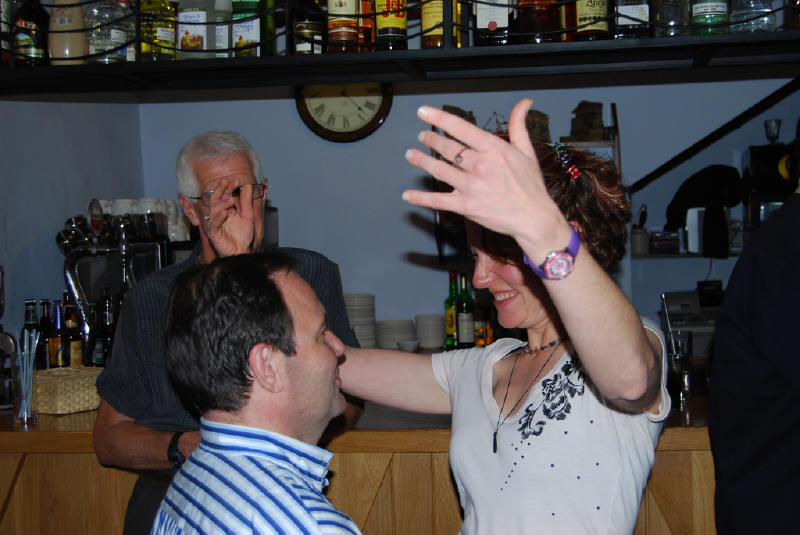
By Friday morning, we arrive at a late breakfast a little bleary eyed, but still speaking English enthusiastically. We do a few more one-to-ones before having an early lunch and piling back on the bus for the drive back to Madrid.
Hugs and kisses are exchanged all around, emails and pictures promised, and often places to stay offered. In fact, after my first week of volunteering, I traveled with some of the Anglos to Toledo for a day trip, before enjoying the gracious hospitality of one of the Spaniards for the next week! After my second week of volunteering with Vaughan Town, I again was offered a place to stay for a night before heading to the airport for an early flight.
The Cultural Experience
Although I initially balked at my decision to focus two of my three weeks in Spain on this volunteer program where I was isolated and not even able to speak in Spanish, I found it to be one of the most rewarding cultural experiences I could possibly have asked for.
Under no other circumstances could I possibly have met so many different Spaniards from all over the country, learned about their lives, and been invited into their homes and hearts. Staying in a hostel, I would never have met any of these people – true locals, much less had so many meaningful one-to-one conversations with them.
Even meeting so many Anglos from all over the world – I now have friends in London, Ireland, South Africa, and the States, to name just a few places. And I will be seeing many of these people again – some soon, some later.
I love Spain as a country, and have vowed to come back as soon as possible. And part of my Spanish travel itinerary – without a doubt – will be to do some more volunteering.
How/Where to Volunteer in Spain, and Other European Countries
Since the original writing of this post (2010), other English Immersion programs have become available in a variety of countries around Europe.
The offering is very similar; English-speaking volunteers get free accommodation and meals in trade for their conversational English services. What differs is the location, amenities, whether or not you will be required to share a room, and length of program. Here’s a summary:
Vaughan Town – Operates 6 day programs in a few different locations throughout Spain. Accommodation (own room), meals, and wine are included for volunteers. Shorter programs may be available to volunteers who are already in the country.
Pueblo Ingles – Operates 6-8 day programs out of a few different locations in Spain and Germany. Accommodation (occasionally shared), meals, and wine are included.
Angloville – Offers 3-11 day programs in Poland, Hungary, Czech Republic, Romania, Malta, England, and Ireland. Accommodation is shared and wine is not included. Many volunteers stay on for multiple programs, extending their overall volunteer time to an average of 4-8 weeks. If you’re interested in teaching English, they have a TEFL Scholarship program that helps you earn your TEFL designation. If you’re interested in working with kids and teens, there are also programs available for that (entailing a lengthier application process including criminal record check).
Speak in Italy – Offers 4-day and 8-day programs in Lombardy, Lazio, Puglia, and Tuscany.

This sounds like such an amazing experience! What a great way to learn about life and culture from various areas of the country. Thanks for sharing!
Great post! I feel as though I were there. And now I want to go myself!
What was the age range of the Anglos? Mostly in their 20s, or all over the map?
Great post! Do you have the information of the organisation that set it up, I would love to complete something like this.
That sounds great! It is also good to hear of some English language opportunities in Europe (especailly one you don’t need a certificate for.)
Definitely bookmarking that website for the future!
What a beautiful town and beautiful experience!!! I would LOVE to do something like that, except I would want to be the one learning Spanish.
I initially worry what I could possibly talk about with so many different people each hour
^ ^ ^ THAT is the funniest line I have read for weeks! xxxx
Really interesting article Nora, thanks for sharing, great way to meet “the locals”
@Kelly – Thanks!
@Laura – No, the Anglos were of a wide range of ages, backgrounds, and nationalities. The intent is to expose the Spaniards to a variety of people – and it made the experience all the more fulfilling for everybody!
@Becky – Vaughan Town has a few different programs in addition to this one, and I don’t think any of them require the teaching certificate. I too, was very happy to have found them!
@Andi – Indeed! There are lots of Spanish-language courses, but I don’t know if any are quite like this.
@Frank – So many different people…so many different conversations….you can’t help but wonder at the onset what you’ll talk about….! 😉
What a well-written entry, you have some serious writing skills in addition to your obvious skill at being a professional hobo!
🙂
@Jessica – Wow, thanks! Coming from you, this means a lot. Please keep reading, as I have many adventures yet to come!
Very cool idea!
Thanks for sharing this post with us.
I would be very interesting in joining one of these programs at some point in time. Was the article you had read just about Spain, or are there other countries involved in the program? Would love to read the article if it’s online or if you can share the URL with us.
Thanks!
@Doreen – Vaughan Town is just in Spain, but I’d love to see this model used in other countries too! As for the original article I found it on, it was over 2 years ago, and as I recall it was an off-handed mention of the program that I picked up on. So sorry – I can’t give you the original link, because I don’t remember it!
What a cool volunteer opportunity! I’m looking for some various ways to volunteer abroad, and not have to pay an arm and a leg to do so.
Thanks again for your article!
@Ninna – Thanks! That article by Julia is a great resource…I love her stuff! Cheers.
Is there vegetarian food available? I’m signed up for Valdelavilla this fall. Any packing advice, too? After reading your blog I’m counting the days so thanks for making this sound so wonderful.
@Nicole – Yes, they cater to vegetarian diets, as long as you let them know in advance. You’ll be eating lots of salads though – be warned! But you’ll get lots of other variety too…the food is great!
As for packing advice, because Valdelavilla is in the mountains, you can get just about any kind of weather. My first week there (in the middle of June was practically frigid with highs around 17 degrees, but two weeks later it was hot and sunny at 30 degrees! So…come prepared for anything, and you’ll be fine! 🙂
Please leave another comment to let us know how you enjoyed the program. Cheers!
I will be participating in the fall and have been looking for a more current review of the program… it was great being able to read yours… still a little nervous about how I will be able to come up with a variety of discussion topics! Other than the walking paths, was there anywhere else in the area to walk to – small store etc?
Thank you.
@Gaby – Don’t worry about discussion topics…conversation flows much easier than any participants (myself included) could ever have imagined!
As for places to go, Valdelavilla doesn’t have very much. No store per se…but again, you won’t feel bored, or in need of anything. Some of the other Vaughan Town locations have different amenities though, with different pros and cons; are you scheduled to go to Valdelavilla?
Either way, you’ll love it! Please let me know how it goes.
Been there! Done that!! And it was as great as you describe. In fact, my two weeks there were my 6th and 7th weeks with Vaughantown. And returning for another week next Friday….A really great program in all aspects!! PS Being from the south (Georgia) with a very southern drawl, I carry Moon Pies for all the participants and guarantee they will speak “southern” by the end of the week…..and they do!
@H.J. – LOL – I loved the different Anglo accents. During my first week, there were a few Irish people who had such thick accents, that even the Anglos had trouble understanding them! On the improv night, the Spaniards poked fun at one bloke in particular for “speaking Chinese”, because it didn’t sound like English! (smiles)
I had already decided to do this.
Because of you, I have reinforced that decision… ten-fold.
Thank you!
– Karl.
@Karl – Awesome! Please stop in and let me know how you enjoyed it. When are you going?
I’m aiming at going there at teh start of its Spring. I’m in Russia right now, teaching English.
I’ve just recently discovered a cheaper-than-expected flight from here to Madrid. But I’ll have to fly from Moscow to Warsaw then from Warsaw to Madrid…
Okay, so I’ll buy a novel! It’s worth it.
@Karl – I hear you! Long haul flights are less than inspirational. But I promise, it will be worth it! 🙂
I’ve just got a question.
The thing is, I intend to do Vaughn Town for a long time. But they don’t cover you on Sundays. Do you know of a good low-budget place to stay on a Suday in Soria?
– Karl.
Although you could find a place to stay in Soria, your transportation is to and from Madrid, such that it’s actually more inconvenient to get to/from Soria (unless you have your own car, which you won’t need for any other purpose). So I’d suggest staying in Madrid….
Are non-native speakers to be considered? I am Italian with years of experience teaching English in Asia. Also graduated in England.
Thanks
Gio
@Gio – They do say that they require native English speakers, however if you detail your experience with them, I’m pretty sure they’ll decide on a case-by-case basis. Go for it! 🙂
Been to one of these sessions and loved it, going back early summer 2011. Can’t wait. I love the hint about taking Moon Pies, I too am from the south, Y’all. Wish I could make them some biscuits and gravy. But I do love their food! And the wine!!!LOL
Vaughantown have accepted my application. I start in July, so that’s all the time I need to prepare. And I found out that you can only apply for up to three one-weel courses at a time – which is fair enough otherwise they’d be bombarded.
I just applied for Valdelavilla, but the other two locations look beautiful enough (just not as deliciously surrounded by green mountains as Valdelavilla). One is more urban and the other is more out in the plains (but apparently gets more cold maonutain air at night).
Have you been to the other two places? (I forgot their names off the top of my head.)
@Judy – LOL! What location are you going back to this summer?
@Karl – I’m thrilled that you’ve been accepted! I haven’t been to the other two places, but would like to. Trouble is, I also love Valdelavilla so much that I’d be sad to miss out on going there too! Ah well…I’ll just have to try them all. 🙂 (PS Valdelavilla can get pretty chilly at night too, being in the mountains).
Do you know the email address of vaughntown.com. Reason being, I cannot contact them since they are using an out of country number. Unless, you know a way to contact them, using an the out of country number? Please let me know as soon as possible. I would love to be apart of this program over the summer.
@Melanie – I checked on the site for you to see if there’s a “contact” page and couldn’t find one at first glance. But if you want to participate in a program, then I’d suggest submitting an application form; there’s space on the form to say extra things if there are specific questions or a special situation you wish to speak to them about.
Melanie – the person to contact for Vaughan Town is Mayte Ziga. Her email is: [email protected]
Sincerely,
Karl Gorman.
Woah! So good I found your description and that too after acceptance. Even though I’m non-native but they accepted saying, they liked the way I approached them and conversed 🙂
I’m going to Valdelavilla, just for a week now for the first week of August this year. Soooo, anyone? 😛
Believe me GrupoVaughan is one of the most amazing things I ever came across. And your weblog gave me inner strength to go and enjoy it!
@Manish – I’m thrilled that you’ve been accepted and are excited about going! August is a perfect time of year to experience Valdelavilla. Say hello to everybody at Vaughan Town for me!
And that I’ll definitely do. On second thoughts, I shall come here again after my experience and share my blog.
I must admit, Couch Surfing and Grupo Vaughan gave me the best reasons to travel and wander around the world :)))
so you get used as an English language workhorse continually asked to converse in English, they get a free English teacher and you don’t get to speak any Spanish at all during the week, nor choose where you end up or get any free days to experience Spain. And you have to pay for your own flight. What do you get out of this exactly?
@Ernie – LOL! I guess if you don’t like meeting new people, having lots of varied conversations (remember, you’re not teaching, you’re just talking), eating three course gourmet meals including wine, receiving free accommodation in a beautiful hotel/village, and having a cultural exchange with locals and travelers alike, then you won’t get anything from the program! 🙂
As for choosing where you go, actually you do have a choice. There are a few different locations that Vaughan Town operates out of, and you apply specifically to the places you want to go.
But far be it for me to defend Vaughan Town. The experience obviously wouldn’t be for everybody. You know best what you’d like.
I got my Spanish language and cultural experience before and after volunteering with Vaughan Town; something that worked out very well, since I was invited to stay with the family of one of the program participants. Again – something I couldn’t have had without the volunteering experience.
What a great post – having discovered the Vaughn system by chance and being S.African (natural skeptics ;), it peaked a keen interest in me, since i have a passion for learning about other cultures and love meeting people from various backgrounds. I have done quite a bit of solo travelling, but never to Spain. I’ve kept returning to the site to do further investigation, but still wasn’t sure…..so thank you for clarifying and i shall definitely be applying with a view to going in June if possible and if accepted. It certainly sounds like an awesome experience!
@Mari – It’s funny you should mention being sceptical…I was too at first! It seemed almost too good to be true. But alas, it’s for real, and you DO earn your keep…but it’s all fun. Enjoy!
Finally….been there done that 🙂
I spent the best week of my life and LOVED what I did. I went to El Barco de Avila, Gredos. And I’m going there back again soon WooHoo.
Thanks for your blog, I got the real energy from your post initially 😉
@Manish – Awesome! I’m so glad you had a good experience. One of these days I’ll try the Gredos location out too – I hear it’s beautiful.
It indeed is beautiful and believe me I’d spent the best week of my life and NOW I just love teaching and be a cultural exchanger 🙂
Though I was lucky to be selected even though I wasn’t a native English speaker. I’m planning Rascafria in March sometime, let’s see. Take care Nora and thanks again!
I just got pre-approved and am, hopefully (once they confirm), going to Avila in the middle of January (so I better wrap up warm!!).
I recently got a training position to teach with Vaughan in Madrid but had to turn it down at the last minute (damn personal reasons!), but I’ll reapply next year.
Thanks for the info Nora. I can’t wait to get there and converse!!
@Rob – Enjoy!
I am too old for this and too poor. I have a peculiarly high culture level, and thus have little tolerance for churlishness, which often happens when “people of many backgrounds congregate.” I don’t think how people like me could fit among “young, rich, and kinky-minded”! Besides, I am 69 years old. My expertise is in English writing, not casual word exchanges, which look great, but add nothing to substantial knowledge! Me disculpen, amigos, pero esto es lo que pienso.
@desert voice – On the contrary, amigo. There were anglos well into their 60s and 70s on both of my weeks of volunteering there. However if you aren’t interested in meeting a lot of new people from all over Spain and the world and engaging in a variety of different conversations with them – some of which might add to your extensive knowledge and others which might not – then I agree; this gig’s not for you. It’s not for everybody, that’s for sure!
PS – Did I say people on the program are “young, rich, and kinky-minded?” I don’t remember saying that. Maybe it was inadvertently implied. Sorry! 🙂
Well I – for one – have LOVED Vaughantown. I did it four times this year (this season, to be precise). Three in the gorgeous Valdelavilla, and one in Puert De Gredos.
It’s been great! The atmosphere, the people, the cuisine (especially in Valdelavilla… the squid in its own ink was amazing!) and the system.
And the self-awareness you get at the end of each 6-day course.
Yeah, I’m being cliche: and I’m telling the truth.
If there’s a small part of you that thinks you will like doing this, then you will enjoy doing this at least once.
At least.
— Karl.
Great posts everyone! I see that most of the comming months are filled and was wondering what winter is like in Spain? The earliest availability is in Janurary and I’m thinking walks on a trail or any outside adventures might be limited due to weather.
At any rate – very intrigued P.Hobo. Been a solo traveler in Europe and have Spain on my list – looks promising – maybe for Spring?
@Chaser – I’ve never been to Spain in winter, but I think it depends on where you go as to what the weather is like. In the Valdelavilla area – bundle up! They do get a little snow. Even in the south in Granada – the city doesn’t, but the nearby mountains do (and are popular for skiing).
I think Spring would be an excellent time, especially if you want to avoid chilly weather.
I am in Spain and have volunteered, so I’ll fill in my experience. I live in Madrid, also winters… it’s COLD because houses are built to keep cool in summer… I volunteered same week in Valdelavilla as Nora, her first encounter. I lent out clothes to freezing inadequate dressed anglos. I got a deep cold… old, humid stone houses. Not that that should stop anyone, the weather was untypical for the time. I am not anglo, but Norwegian. I learned English for everyday use while living in Australia for nearly six years. I was impressed by the total experience of the anglo group. Some I would have loved spending long night listening to and talking with. Some I actually keep in touch with, and lend a room when they do repeat volunteering… Pity is, one does not get much time to get to know, as the spaniards are the priority. They in turn are not average spaniards, but alfa-males used to be heard. With some exceptions maybe, but their education and social rang is high. I do not mean this wrong, just that these (men) are used to speak -and tell how things should be (done), so it’s a challenge to them in addition to a language they don’t master. A person with a “peculiarly high culture level” might find a lot to learn if her/his intellect matches the piled up knowledge of culture… Spanish culture and history is amazing! Spanish food is also excellent, but spoiled by living here (Madrid) three years I can not prize the Valdelavilla Kitchen as gourmet; it’s good, and more than plenty, but not SPANISH gourmet. The wine was ok, but substantially better can be found at 4e/bottle. Well I am spoiled haha. And where was the CAVA? I absolutely recommend volunteering if it excites you, but add days to your trip to get a Spanish experience. Vaughantown is not a Spanish experience, it’s an unique experience… it’s hard work in one sense as all day is scheduled, it’s good training for aspiring teachers, it’s not teaching but conversations. I gave a flying lesson in one of my sessions, as I had a pilot licence, in another session the spaniard gave me a fitness instruction, original and passionate. An the entertainment on the nights were great fun, the talent on stage impressed!!!
Kristen, loved your description and also info on life in Madrid. have you ever heard of any at home programs in madrid…..more or less stay with a family or even a solo person?
i like to think of it as immersion in a culture…..
i have followed Vaughn village for perhaps 8 years or more. when they split up (the founders) i tried to join the Italian village but it is almost impossible to find and contact…. and once i found you must sing or do skits, i stepped back….i am not theatrical
I learned about Vaughan Town while listening to a Rick Steves’ podcast. Intrigued, I applyed and was accepted. I will be attending the program in either December or January. While I certainly am not shy and have no trouble talking to people, I am a little trepidatious about keeping the conversation stimulating for hours on end. And about these evening performances…I’m afraid I haven’t the talent to entertain a group. Those are really the only two things I am reticent about. Can you allay my fears?
My first Vtown was Dec 2011, I traveled with a friend and we had somewhat different experiences. She is more social than I and really connected with many Spaniards. I associated with all but only ‘connected’ with some. I am returning in September and cannot wait, as a long time traveler in different capacities. This program is well organized and great fun! Relax and enjoy!!!!!
Hi Jane,
I’m glad you’re excited to return! As you have discovered, even if you’re not a complete social butterfly, there’s a chance to connect with at least a few people – and for me, a smaller number of true connections beats a wider array of loose ones.
Enjoy!
@Kristin – Thanks for weighing in! How are you and your puppies anyway? 🙂 I didn’t have quite the same experience about the Spaniards being high-ranking men; and in the 2nd week there were even University students as Spaniards, and always a good mix of men and women.
But I DO agree that if you come to Spain, it’s good to tack on a few extra days for some Spanish sight-seeing, since the schedule is very full and a little bit top-heavy.
@Jan – Don’t concern yourself at all about keeping conversations going for hours on end….you’re never talking to one person for more than 40 minutes before you get a break and are matched up with a new partner, so there’s no time for things to drone on. And if you’re really stuck for topics, they have tools for that as well. You’re not the first person to be concerned about this!
As for the evening performances, don’t worry about having a talent or having to entertain. Again, it’s all very well organized and coordinated, and you don’t even have to get up in front of anybody at all if you don’t want to. It’s all voluntary!
Enjoy. I know you will! 🙂
Hi Jan. Trust me, they will not force you into doing a production if you don’t want to. In fact, in one of the “anglo only” meetings, the director is likely to say “Do not force any of the Spaniards into doing a production they don’t want to.” You will be required to be very active, and avoid speaking Spanish 100%, but you will not be required to act (on the last night IF YOU STAY UP LATE, you are likley to be required to get up and dance – though… by the other Spaniards, not the Vaughantown crew).
You will reminisce about this experience. I am, deeply, and I already look forward to doing it again some time.
— Karl
Thanks P.Hobo and Karl! It’s nice to know I now have someone to whom I can address other questions. I love to travel, but sometimes, especially when you are traveling with someone else, it’s hard to actually meet people and have a genuine window into the culture. I welcome the opportunity to meet other ‘anglos’ as well! The whole program really sounds like a lovely experience.
I hadn’t thought much about my experience in Spain, nor Vaughtown lately but have just received a few of your “Hobo” blogs and felt a need to reply. I went to Valdelavilla in Oct 2010 and had a wonderful time. I am 54 years old and met wonderful people from various english speaking countries, in addition to the fun spaniards that were attending. I had a trajedy in my life shortly afterwards and received some very supportive and heartwarming e-mails from some of the attendies.. Just like most traveling that one does, sometimes you enjoy some aspects more than others, but this was a great experience and some day would do it again. By the way, I was able to spend some time before and afterwards in different parts of Spain, which I think is definitely a must if you have the time/money.
Does anyone know if the Vaughan Spanish School is stilll in operation? I sent in an application for the volunteer week in June but haven’t had a reply, not even an acknowledge that they received my application.
I had previously inquired about the retired teachers’ assistant teacher program but, again, did not hear back from them.
Anyone know anything? The last post is Nov. 2011, so I would think they’re still in business.
@Sandy – As far as I’m aware, Vaughan Town it still in business. You may want to send them another note just in case they missed your application.
Nora….I’m so glad that long back I saw this and went to do the VT and thoroughly enjoyed every bit of it and its surprising that Karl was there too in the same week session as I. And now going back in a week again and right in time for Feria De Sevilla 🙂
@Sandy: They ARE in business. And they are growing. I can understand that currently ONLY Mayte is in-charge of recruiting volunteers and maybe her work load if way much and she misses, quite a few applications. I’ll definitely ask her this time about why it happened and maybe get back with a genuine reply for you.
Hi all. @Sandy, all I can say to rationalize why they took a while getting back to you is because Madrid has recently hit a major crisis, and there’d be a lot on their plate right now.
When I say a major crisis, I mean one that’s more major than it has been the previous six months . . . give or take. When I was in Madrid there didn’t seem to be LOADS of visual evidence of such problems – but that was the middle of last year.
It’s Autumn right now in Australia, but the sunsets have been reminding me of Spain.
— Karl.
It is several years since my last pueblo ingles experience, but I am looking forward to finding the time again in future. I’ve been twice: once to Valdelavilla and once to La Alberca. Thoroughly enjoyed the experience. A friend of mine went in June this year and also loved the experience. So it is definitely still operating.
While I had a wonderful time, I thoroughly agree that the experience is not for everyone (but what is?). You don’t need to be an entertainer, nor a teacher; but you do need to enjoy spending time with other people and you need to be able to think about the needs and interests of others. In exchange, you get the great pleasure of interacting with interesting people in a very comfortable setting: good food, good wine, good conversation, lovely setting; and it’s free. Can’t ask for more.
@Lee – Great observations about the program! I’m so glad you’ve enjoyed it. I have such fond memories of Vaughan Town.
Thanks for this post! I’d really like to do this program one day. Do you know if there is an age requirement to apply? I’m 22 right now. Thanks again for writing about your experience, it sounds exciting.
Hey @Tina – I think the minimum age to participate is 18. They like to get volunteers of all age ranges, accents, and backgrounds, so you should be golden! Enjoy.
Thanks for the post, sound exciting but hard… Im a spanish student that tomorow will goes to the VT… I’m excited and i hope improve my english an make new friends. Please wish me luck
Hola Rafa – Good luck! I’m sure you will have a very good time. It will be hard work for you, and halfway through the week you’ll be exhausted. But you’ll get a second wind and by the end of the week, and English should flow much more easily!
Please check back to this site and let us know how your experience was as a Spaniard!
Have a great time Rafa. You will be amazed at how much better your English will be by the end of the week.
(Try the squid cooked in its own ink. It sounds weird but its magnificent!)
It is really nice to read about your experience. I am considering to do this same assignment soon as I am awaiting for a new job.
Jayshri
Enjoy Jayshri! I’m sure you will.
Thank you so much for the info – the comments and answers were really helpful to read through as well! As a 20 year old Canadian backpacker, I can’t help but be slightly skeptical – the program sounds too good to be true! I was accepted into the young adults program commencing in August, but there has been a lack of communication in regards to the details. I just received an email today asking me to confirm my participation with a flight number and hotel – I don’t know where I will be flying from or where I will be staying (once again, backpacker).
I’m mostly wondering, is this a legit organization? I know that Spain has been under a lot of finacial stress. Are they still able to run the program? If so, is it worth purchasing a flight to confirm my spot so that I don’t lose it?
I look forwards to your reply!
Hi Alison – I don’t know anything about the Young Adults Program, so I can’t comment on that – maybe it’s new.
But if it’s part of the company Vaughan Town (and I would assume your contact is Mayte, though if it’s a different program your contact person may be different), then I can vouch for it!
I know – I initially thought it was too good to be true, and I had an expensive flight to book in order to confirm. But rest assured, you earn your keep – and you’ll have fun too! 🙂
As for where to stay in Madrid, I believe the Vaughan Town website has some references to hostels and hotels they recommend.
Hi Allison,
I am not sure for which date you registered but I just signed up for Feb 3rd. I had the same reservations as yourself. I attended this meet-up group past Sunday, which had many people who had done this program. After speaking to them I felt as ease. So I finally confirmed my trip yesterday and will be going there on Sat. Lets see how it is. May be I’ll see you there.
Jayshri
Hey Alison,
Yes, VT is a legitimate organization. I’ve done it twice and going back again soon this year end. The people and the experience you get will shape your way of traveling and at the end of imparting something which you own (English here), you will feel so confident and happy.
Trust the comments and book that flight, that is the only thing you will mostly pay for 🙂
Ah! Taking about the financial stress in Spain…..when I reached Madrid in April this year, their stock market crashed, but I never saw any difference in the mood of people anywhere. I love Spain 😀
Enjoy 🙂
Oh and flight number is important, just so they are sure that the Anglos don’t go missing for the Tapas :P. And for stay you can easily find good and economical hostels around SOL (Euro 12-30 is a good range). And Eurobuilding apartments where their Tapas evening is held always, has big apartment with all facilities for Euro 55 [I got free WiFi and breakfast too] 🙂
Hi Alison.
Trust me, not only is Vaughantown legit but I found it to be well organized.
I highly recommend you go to the Madrid hotel on the evening before the one-week course starts (they’ll fill you in on where it is exactly). If you do, you will meet the coordinators and other English-speakers who will be doing this. It is a wonderful ice breaker. If you’re going to Valdelavilla, the 16th century village, your palate will not be disappointed!
But bare in mind, you WILL earn your keep. The work they require you to do – talking and talking to Spaniards – is easy… but you will be required to do it a lot. It is easy, but constant, and you’re under a strong requirement to do it at every meal time (where apparently Spaniards learn the most English).
And the only late night you should allow yourself is the last night in the village.
As a senior (72) female, wondered if I would fit into the Vaughn Town program. Retired admin. assistant, B.A. & Secretarial Science diploma, Canadian, travelled a lot. My friend has mentioned this to me and we were discussing possibly October if there is a week available then for volunteering to speak English with the Spanish people.
Hi Pat – Absolutely! Vaughan Town is very attentive to making each group very diversified – in accents, age, and background. Go for it!
Hi Pat. They will be very welcoming, to someone of your age, and don’t be surprised if one or to (or more)of the Spanish people you meet will be of the same age group as you. — Karl.
Hey Alison and Karl,
Pat Kenna and I were thinking of volunteering together in Valdelavilla for a week with Vaughan Town in October, 2013. I am aged 66 with a B.Admin. degree and 30 years of municipal government experience as a real estate appraiser in Canada.
My question is “Can two friends volunteer in the same place/town during the same week?”
Hi Alanna – Yes, friends can volunteer together, as I met quite a few groups of friends and couples there. I believe you simply need to stipulate it in the application process.
Hi Alanna. I met a husband-and-wife and a mother-and-daughter who did a week for vaughantown. It should be fine. — Karl.
Hi, I have been looking on the website for dates and see that they only go up to August 2013 and yet people here are talking about going in October. Where are they getting this infomation?
Thanks
Karen
Hi Karen – I’m not sure. But I’ll bet if you send the folks at Vaughan Town an email they can help you out. Mayte (the woman who handles most volunteer stuff) is fabulous.
Hi,
I’m volunteering with VaughanTown in August, at Gredos however. I just was wondering what sort of age range attend? I noticed they now have a young adults programme for upto 23 year olds, but I’m doing the older group as I’m 24. It all sounds really good though and I’m very excited!
Niamh
Hi Niamh – The age range that comprises the standard program is huge! You’ll get one of everybody there; the intent is to have a wide cross-section of cultural backgrounds, ages, and accents. When I volunteered there, there were volunteers ranging from college students to retirees.
Have fun!
I was glad to see that older Anglos would be welcome at Vaughan Town, as I’ve thought about attending for a couple of years. I also looked at Pueblo Ingles, although maybe that’s the same organization? Something I read a couple of years ago made me think they would be reluctant to admit a teacher, especially a former ESL teacher, to the program. Is that true, and would it help in that situation if I have never taken Spanish in school?
Hi Volare,
I have no idea what factors into their criteria. I met teachers there (who were Anglos), but not ESL teachers. The only reason they may be reluctant to accept an ESL teacher is if they think you’re going to try and teach English too much instead of just speaking it. This program is about learning through conversation, not lessons.
As for Spanish, you’re not allowed to speak one word of it! So not being able to speak it is certainly a “strong” point.
The reality is you just need to apply, and see what happens. They have a million criteria they need to satisfy in putting together the groups of Anglos, and I’m sure some of it is independent of your own experience. You’ll never know unless you give it a go! 🙂
As for Pueblo Ingles, it’s a different company, running almost exactly the same program from what I can gather – with a few small differences in program structure, location, and length. I know people who volunteered with them, and enjoyed themselves very much.
Thanks for all the good info. Nothing ventured………….
Does day after day, night after night of talking become exhausting?
Hi Volare. Trust me, they will be fine because I did four weeks of Vaughantown (not in a row) and I am an ESL teacher. They were totally happy with me. And the fact that you don’t know Spanish is no problem because their one absolute strict rule with your teaching methods is you must never – at any time – speak in Spanish. (Unless it is an emergency.) — Karl.
Thanks, Karl. I was somewhat concerned about my being an ESL teacher. I have picked up some Spanish from my Mexican students, but probably not enough to get in the way. Have you volunteered at the same location each time you went?
Hi Niamh,
I took the course last February – March as a student and I liked a lot. The volunteers were very nice and I am sure you will ejoy it. I took the course becase I wanted to practise my English as I moved to Dublin last March. I am very happy with the experience. By the way, considering your name you are probably Irish… I have to tell you that the best friend I met there is from your cuntry 🙂
Fernando
Hi Fernando,
Thanks for your message – it’s good to know! I’ve just booked my flight to Madrid so I’m feeling much more excited now! You’re right about the name, it’s Irish, and my mum is – but I was actually born in England 🙂
I volunteered to as many different ones a s I could, but the only ones that had spaces available ate the time was Valdelavilla and Puerta De Gredos. (Not complaining, though.) However, there is always the chance of a last-minute drop out just before a week starts. They have meeting nights on the evening just before one of their courses – for the teachers only – where they will be able to tell you weather or not there are sudden spaces (or just email them and let you know you are available in case there are drop outs).
Hi all,
I’ve just applied for a program in January. How long until I hear anything? And will they let you know if they reject your application?
Hi Carmel,
Sorry – I have no idea of the answer to either question. Hang tight, and do send them a follow-up email if you’re getting antsy. Hope you get in!
Was just accepted today!Really looking forward to it now, cant wait!
Can you tell me if the Program is held ongoing? Thinking of applying for April or May dates 2014. Do you stay in Madrid overnight? Is there transportation provided to and from the village and Madrid?
Would be wanting to book the same week as my friend (female)–separate rooms.
I will be 73 in January. Assuming you still accept retirees…..
Ms. Pat Kenna
I did it this summer and there were retirees there and also pairs of friends who were in separate rooms – I volunteered at Gredos though. You need to book your own accommodation in Madrid the night before but you are given transport for Madrid to whichever programme you’re on 🙂 have fun! You will love it!
Hi Niamh,
I’ve been accepted for a program in January in Gredos too! Did you also have to book accommodation for one night after the program finishes, like on the Friday night? Any other information you could give me would be great!
Hi Carmel,
Yes, you need to book your own accommodation for the Friday night after the program ends, but you don’t need to have the reservation to confirm your placement with Vaughan Town – just the first Friday.
Other than that….have fun!
Re: Valdelavilla — for speaking English with Spaniards\
In your application form site you do not list Valdelavilla as one of the programs – there are three others listed, noting which dates are filled and which dates have vacancies.
If there is a schedule for Valdelavilla on the website can you direct me to it. That is the one that my friend and I are interested in attending. We have not made an application yet.
Thanks.
It bears noting again, that I have no affiliation with Vaughan Town. I don’t work for them, nor do I accept or process applications.
PLEASE DIRECT PROGRAM-SPECIFIC QUESTIONS TO VAUGHAN TOWN DIRECTLY: http://volunteers.grupovaughan.com/vaughantown
what is a good reasonably priced hotel to stay at in Madrid before/after the Vaughantown week . Would be flying from Canada. Do not have dates as yet but would be most likely February 2014. Any suggestions. Perhaps you would know where the Tapas Party gathering is held and that would help to locate a hotel near there. Thanks.
Hi Pat,
I’m going in January and I’ve booked the Amaral on a friend’s recommendation. The tapas reception will be held in Eurobuilding 2 ground floor in El Serpentin. The Amaral is located 250 metres away. Hope this helps you!
Hi, has anyone been to El Rancho, and what is it like? as going at the end of June for the first time. Thanks,Joyce
What a fascinating experience this would be. Does anyone reading this know of similar enterprises in other countries?
My biggest concern: my own ability (or lack thereof) to not fall into Spanish!
Hey Kate,
I don’t personally know of any programs like this in other countries, but they may exist.
As for the Spanish, just don’t. You can’t. It’s easy enough when NOBODY is allowed to speak Spanish, under threat of being removed from the program.
Hi! I have been accepted for Vaughan Town/Gredo this Spring — ’14, which will be my first trip to Spain. Any and all advice is very much welcomed. I am becoming familiar online with transportation from the airport to the Eurobldg and deciding on a hotel for Friday and Saturday nights before departure to Gredo. Then I will get a travel itinerary to enjoy 5 days in Madrid/Barcelona before returning to the US. I imagine the dress is casual — are jeans and athletic shoes okay? Is food available before the 5-8 pm session or is there a break? Waiting until 9 pm for dinner is my biggest concern. Looking forward to a great time!
Hi Janice,
Yes – jeans and athletic shoes are just fine; when I was there (granted I wasn’t in Gredo) the dress was pretty casual….at least a European sort of casual – Europeans typically dress with lots of style, even if they’re only wearing jeans!
And really…don’t worry about the food – you won’t go hungry! Remember – you won’t be finishing lunch until almost 3pm…you’ll get into the swing of things – Spaniards like their food, and nobody starves.
Hi Nora,
Thanks so much for this article. I have been accepted and am doing some research about VaughanTown and other peoples experiences before I book my flights. You have wrote a brilliant article about your time there. I am now fully convinced and about to book my flights to Madrid. I have a week in September and am really looking forward to it. Thank you again for this article and a wonderful insight of what we could expect.
Hi David,
I’m so glad this article gave you the information and enthusiasm to book your flights! It’s a fabulous experience.
I may be interested in volunteering for a week or two this year. I am an australian native english speaker. I have italian as a second language.
Please advise if there are opportunities for doing this and also, details on the best way to get there. I will be coming from Pisa in Italy.
Warm regards,
Catherine Stanley
Hi Catherine,
You can apply here:
http://volunteers.grupovaughan.com/vaughantown
Nora,
This interests me. I’d like the cultural experience. However, the one lady said the Spaniards are mostly Alpha Males. Was that your experience too. Were the Spaniards mostly men or was it a balance?
Klay
Hi Klay,
In my experience with Vaughan Town, I found there to be a wide cross-section of Spaniards in the program. I guess it varies from week to week; generally speaking, the Spaniards participating are there because their employers are paying for them to be there, thus they’re fairly high-level employees, and so it stands to reason that at times there may be a larger concentration of “Alpha Males”.
But I wouldn’t let this dissuade you from participating; the folks at Vaughan Town are pretty conscious of putting together groups of diversified people.
Hope this helps!
He Klay. I’m an Australian ESL teacher, and I can verify that the women in Spain bewilder foreign men just as much (and maybe even more) than Spanish men do to foreign women. So you have a balance from that.
But in the end of the day… they NEED to learn English and it is run by VERY professional people that will keep an eye out for any such problems as what you’ve implied (none of which I ever witnessed the 7 times that I’ve been there).
Hi All,
The one time I did the Vaughan Program, there was almost an even split of men and women amongst the Spaniards. Even the English speakers were evenly split sex wise. There was a cross section of people from different age groups(25-75), cultures and countries amongst the English speakers. Amongst the Spaniards, most if not all were under 55 and very friendly. Not sure where and why Spanish guys are Alpha Male. I met a number of them and by no means are they Alpha Male. Book a week and enjoy your time speaking English.
Vaughtown was an amazing experience which I am considering doing again. However, I was wondering if there is a similar program in Hungry?? ie Budapest???
Hi Nancy,
I don’t know of one, but if you find a program like this, please let us know here!
Hi Nora,
Thank you for providing all this information . It is very helpful. I am in Rome enjoying
the sites. As of this writing I’m still looking for a volunteering program for Barcelona
or Madrid . I’m not panicking. God is good. I leave Rome sunday for Barcelona .
I sent out 40 emails to the freeloader sites, 25 to wwoofing but haven’t received any
positive reply. In life for good things to happen one must stay positive. I know that
I will have free room & board soon .
Best Regards,
Cecil.
Hi Cecil,
Keep on trying, and stay positive! Often, it’s necessary to cast the net wide and see what comes in. Good luck, and happy travels.
I so enjoyed my Vaughtown experience in May 2013 that I am considering do it again. I was in Gredos where I looked out my window at the snow capped mountains, worked hard but met wonderful people. It was the experience of a life time.
I’m glad you had such a great time, Nancy! I met a few people whilst volunteering at Vaughantown (both times) that make it a regular thing. Have fun!
Oh Puerta De Gredos… that’s a hotel that makes you feel like a millionaire. (And the castle AVILA, which is relatively close, is magnificent!)
For the record – VaughanTown had to stop working with Valdelavilla. Despite a good past with each other they had to separate from/ each other over technical matters.
They have some new venues that are staggering! One of them is in Pamplona (or near Pamplona).
Sweet – thanks for the info, Karl!
Searching for the spelling of Valdelaville for a post I am writing about travel I found this great post by Nora. I have many found memories of the amazing cultural experience in Spain. The free accommodations, food and wine were a real treat. Nora has written an excellent post describing our experience attending the Vaughan Town program. The guy standing up with the beard and blue shirt during the meal picture is me. I had a great time in the small historic village of Valdelaville, Spain and the cultural interaction with the Spaniards while we talked and walked along the trails. It was great to learn more about the history of Spain and the Spaniards passion for flamenco, flavors, food and fun. It was a 4 hours bus ride north of Madrid and the bus ride gave us an opportunity to get to know each other. We enjoyed a nice lunch along the way. Being in this remote location allowed us to interact without the distractions of cell phones, radios or television. The food was fantastic and the conversation was lively. I especially enjoyed the group performances, celebration dinner and dance the last evening. I am looking forward to returning again for more events in the future.
Hi Michael!
Great to reconnect with you…didn’t realize you were famously profiled on my site, did you? 😉
Too bad they don’t have programs at Valdelavilla anymore, but I hear they’ve got a whole host of other awesome locations on tap! Are you on schedule to volunteer with them again?
Hi Nora,
I’ve done both Vaughan Town and Diverbo/Pueblo Ingles (similar program in Spain) as well as similar program Angloville in Poland but have been searching for similar programs in other countries like France or Portugal. Do you know of any other than these guys? My intense research has wielded not many results other than a program in China and the one in Argentina. Travel costs make those not of interest to me..
I’m actually writing a series of articles on this process right now
thanks in Advance!
Brooke
Hi Brooke,
I don’t know of any other similar programs, but I’m curious to see what you find! Looking forward to reading your post…please post a link to it here once it’s published! 🙂
Hi Nora!
I’m at my second Vaughantown as I type, and have written a few posts about these programs on my blog (here’s one link to a post I did about the Poland program I volunteered at: http://www.adifferentkindoftravel.com/poland-ill-miss-you/ )
but also will have an article being published soon in a travel publication (sort of an overall view of doing these programs as a solo traveler in Europe )
I found references to a program in Argentina and in China for similar programs but need to do further research to find out more specific details about what’s included/how they work, etc
more soon!
P.S. I have heard some great stories about you at Vaughan town with your tiny backpack, yet always looking amazing (from the MC’s….) hahahah what a small world
Hi Brooke,
I can’t believe they STILL remember me at Vaughan Town! I’ve had the best of intentions about returning, but it just hasn’t come together yet. One of these days – hopefully!
Unfortunately I can’t seem to load your link (welcome to Peru – it’s a random internet situation at best!), but I’ll keep trying.
Please give my regards to the crew at Vaughan Town!
Hi Nora,
here’s a link to the post I wrote about Immersion Programs:
http://www.adifferentkindoftravel.com/free-four-star-accommodation-and-meals-in-europe-in-exchange-for-speaking-english/
It’s also published on Hubpages, but to be quite honest I think I”m going to ask them to take it down since they don’t publicize at all, don’t allow links to your site, and don’t pay (I had offers to publish it elsewhere for pay but couldn’t once it was on their site)
Hi Brooke,
I don’t know much about Hubpages, but given your description it seems like it’s not worthwhile. Strangely enough, I can’t load any pages on your site, including the links you gave me above. Hopefully it’s my connection, and I’ll be able to read your article – which I’m quite interested in – shortly.
Hi Nora,
hmm… don’t know why! my link works on our end here. hahah Peruvian wifi must be as dubious as italian….
B
Hi Nora,
I am soooo glad I found your website, there is so much useful information here! I am now applying for the same program and can’t wait when I actually go!
I wanted to ask if you can recommend any (literally any) volunteering or working opportunities that would be available in Central or South America. I found a few on my own, but don’t feel 100% confident about those companies. I would be so grateful for any type of feedback.
Thank you much!
Anya
Hi Anya,
Welcome! 🙂
Other than house-sitting, I haven’t done any volunteer/work-trade gigs in Central/South America. I’ve conversed with a few people who have, with varying degrees of success. Generally speaking, the cost of living/accommodation is low enough to begin with that the value received for volunteering in trade for it is somewhat diminished. You might want to check out these posts for more on this topic: https://www.theprofessionalhobo.com/the-creative-guide-to-free-or-cheap-accommodation/
https://www.theprofessionalhobo.com/the-creative-guide-to-free-or-cheap-accommodation/
However once you arrive to your destination(s) in Latin America, you might find informal opportunities to be of service through word of mouth.
To apply more of a science to it, here are some sites you can check out to explore volunteer opportunities:
https://www.theprofessionalhobo.com/the-creative-guide-to-free-or-cheap-accommodation/
Hope this helps!
I have applied to be a volunteer in July, 2017. Does anyone have experience with this site?
At the Belmonte site.
Hi Nora. I love this article about Vaughan Town and Valdelavilla. I notice that its a few years old and I’m now wanting to do the program. So far in my research I’m not finding Valdelavilla listed on their website. It looks like the best possible location from your article. Do you happen to know if they are using that site any more? Am I missing something?
Hi Sandy,
Yes, I think they’ve since closed down the Valdelavilla location. But they’ve also opened up a number of other locations around Spain. I’m not familiar with any of them, but I suspect they’re all great! I hope you try it out; it’s a lot of fun. 🙂
Do you know of other things similar to this anywhere else?
Sandy,
I think this is a pretty unique program. I’ve not found anything like it elsewhere in the world.
I’ve signed up for the program and just want to make sure it’s a legitimate program.
Hi Kathy,
Yep – it’s legit! I think the sheer number of commenters here who have also done the VaughanTown program is testament to that. 🙂
Oh yes! It’s a great program and tons of fun. I did it last year (2017) and would do it again anytime I can manage it. Very professional, organized and communicative. But probably best to try to sign up before the summer because they fill the spaces by now for the most part.
For anyone wanting to go to Valdelavilla, it is no longer one of the sites they use, but all the others are wonderful. The accommodations are excellent and you never go hungry.
I have heard there’s another program like VaughanTown called Angloville which is in places like Poland, Bulgaria, Romania, Malta. I haven’t been there but a friend just finished and if anyone wants to know about her experience let me know and I will get in touch with her about it. I think she liked it and she loved Budapest.
Hi Sandy,
Yes, both Angloville and Diverbo are alternatives to Vaughan Town. I’ve added a section to the end of this post with information and links to both places. The nice thing about Angloville is that they do have programs in some other European countries too (though from what I gather, the accommodation is almost always shared, and wine is not provided). 😉